Kamis, 28 Januari 2016

Knowledge Management Tools


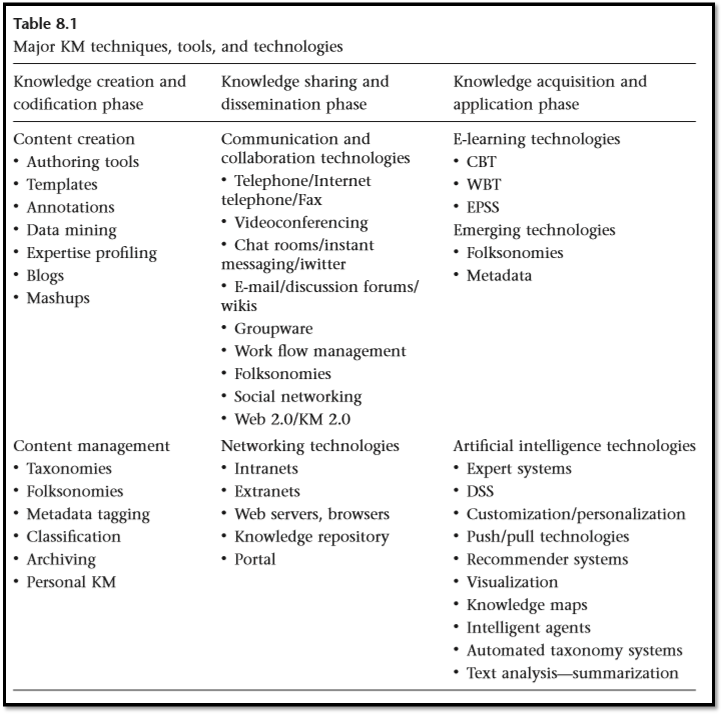
Technology is used to facilitate primarily communication, collaboration, and content management for better knowledge capture, sharing, dissemination and application. 
Many dimension are involved in describing knowledge management tools.
Ruggles (1997) provides a classification of KM technologies as tools that:
1. Enhance and enable knowledge generation, codification and transfer.
2. Generate knowledge (e.g., data mining that discovers new patterns in data)
3. Code knowledge to make knowledge available for others.
4. Transfer knowledge to decrease problems with time and space when communicating in an organization.

Knowledge Capture and Creation Tools


Content Creation Tools
Authoring tools, the most commonly used content creation tools, range from the general (e.g.,word processing) to the more specialized (e.g., web page design software).

Annotation technologies enable short comments to be attached to specific section of a text document, often by number of different authors (e.g., by making used of the track changes feature in Word). 

Data mining and knowledge discovery are processes that automatically extract predictive information from large database based on statistical analysis. 

Blogs, is a term for a web log – a popular and fairly personal content form on the internet. A blog is almost like an open diary; it chronicles what a person wants to share with the world on an almost daily basis (Blood, 2000).

Mashups is an innovative way of combining content (Merrill, 2006). Mashups are web applications that offer an easy and rapid way of combining two or more difference sources of content into a single seamlessly integrated application. 


Content Management Tools

Folksonomies and Social Tagging/Bookmarking

Metadata is referred to as tags or keywords. Metadata is literally translated as data about data and refers to specific information about content contained in books, reports, articles, images and other containers so that they can be organized and retrieved in orderly fashion.

Social bookmarking is a method whereby users participate directly in the storage, organization, searching and managing of web resources. 


Folksonomies and Social Tagging/Bookmarking

Folksonomies differ from traditional taxonomies in that there is no hierarchy, no object-oriented style of inheritance from parent object to child object just clusters of tags that appear to be loosely related. 

Personal Knowledge Management (PKM)
Tools for personal information management are impressive and, if you think about e-mail and portals are already widely used

Newer tools such as blogs, news aggregators, instant messaging and wikis represent a new toolset for PKM.

On an information-management level, PKM involves filtering and making sense of information, organizing paper and digital archives, e-mails and bookmark collection.


Knowledge Sharing and Dissemination Tools

Social Networking, Web 2.0 and KM 2.0 2.


Social Networking are dynamic people-to-people networks that represent relationships between participants.

•Wladawasky-Berger (2005) notes that social networks are “knowledge management done right” as they address similar goals to solve problems, increase efficiency and better achieve goals. 

The combination of social networking, blogging, wikis, and other related technologies together define Web 2.0 or the next generation of the web.

KM 2.0 is analogous to Web 2.0 and refers to a more people-centric approach to knowledge management. 

Traditional KM (KM 1.0) is based on knowledge repositories, the storing and preserving of knowledge but in a largely static fashion.

KM 2.0 represents a new paradigm and much like the core attributes listed for Web 2.0.

Features of KM 2.0:
1.Contribution :
2.Sharing
3.Collaboration
4.Dynamic
5.Reliance


Networking Technologies

Networking technologies consists of intranets (intra-organizational network), extranets (inter-organizational network), knowledge repositories, knowledge portals, and web-based shared workspaces.

Three types of knowledge repositories:
1.External knowledge repositories (such as competitive intelligence)
2.Structured internal knowledge repositories (such as research reports, product-oriented market material)

3.Informal internal knowledge repositories (such as lessons learned)


Portals are means of storing and disseminating organizational knowledge such as business processes, policies, procedures, documents and other codified knowledge.

Portal serve to promote knowledge creation by providing a common virtual space where knowledge workers can contribute their knowledge to organizational memory.


Groupware and Collaboration Tools

•Groupware represents a class of software that helps groups of colleagues (workgroups) atached to a communication network (e.g., Local Area Networks [LANs]) to organize their activities.
•Typically, groupware supports the following operations:
1.Scheduling meetings and allocating resources,
2. E-mail,
3.Password protection for documents,
4.Telephone utilities,
5.Electronic newsletters,
6.File distribution.

Wikis are web-based software that supports concepts such as open editing, which allows multiple users to create and edit content on a website.

Today two types of wikis exist: Public wikis and corporate wikis


Knowledge Acquisition and Application Tools

E-Learning systems provide support for learning, comprehension, and better understanding of the new knowledge to be acquired.

Tools such as EPSS, expert systems, and decision support systems (DSS) help knowledge workers to better apply the knowledge on the job. 

Intelligent Filtering Tools

Intelligent agents can generally be defined as software programs, which assist their user and act on his or her behalf, such as a computer program that helps you in newsgathering, acts autonomously and on its own initiative, has intelligence and can learn, and improve its performance in executing its tasks (Woolridge and Jennings, 1995).

The following features are necessary to define a true intelligent agent :
1.Autonomy
2.Social ability
3.Responsiveness
4.Personalization
5.Initiative
6.Adaptivity

7.Cooperation

Knowledge Sharing & Communities of Practice (CoP)

Once knowledge has been captured and codified, knowledge needs to be shared and disseminated throughout the organization.
The IDC study estimates that an organization with 1000 knowledge workers loses a minimum of $6 million/year in time spent just searching for information.
The cost of reworking information because it has not been found costs that organization a further $12 million a year. 
Technology offers a new medium through which employees who share similar professional interests, problems, and responsibilities can share knowledge.
This is typically through e-mail groups, discussion groups, and other interactions in some sort of virtual shared workspace that is typically hosted  by organization’s intranet and they are often referred to as CoPs
A community of practice refers to “a group of people having common  identity, professional interests and that undertake to share, participate and establish a fellowship” (American Heritage Dictionary, 1996).
It can also be defined as a group of people, along with their shared resources and dynamic relationships, who assemble to make use of shared knowledge, in order to enhance learning and create a shared value for the group.
The term community suggests that these groups are not constrained by typical geographic , business unit, or functional boundaries, but rather by common tasks, contexts and interests.
Practice implies knowledge  in action – how individuals actually perform their jobs on day-to-day basis as opposed to more formal policies and procedures that reflect how work should be performed.

Sociograms and Social Network Analysis
The process of SNA typically involves the use off questionnaires and/or interviews to gather information about the relationships among a defined group or network of people.
The response gathered are then mapped using a software tools specifically designed for the purpose.

Key stages of the process will typically include:
1.Identifying the network of people to be analyzed
2.Clarifying objectives and formulating hypotheses and questions.
3.Developing the survey methodology and designing the questionnaire.
4.Surveying the individuals in the networking to identify the relationships and knowledge flows between them
5.Use a software mapping tool to visually map out the network
6.Analyzing the map and the problems and opportunities highlighted using interviews and/or workshop
7.Mapping the network again after a suitable period of time

Types of Communities
 Types of Communities
Roles and Responsibilities in CoPs
Kim (2000) lists the key roles as
1.Visitors
2.Novices
3.Regulars
4.Leaders
5.Elders

Roles & Responsibilities in CoPs

1. Visitors may visit once or twice and may or may not join. At this point, they are merely curious and seeking to find out what the community is all about.
2. Novices are new members who typically stay on the periphery until they have learned enough about the community and the other members.
3.At this point, they become regulars, members who provide regular contributions and who interact with other members on a sustained basis.
4.Leaders are members who have the time and energy to take on more official roles such as helping with the operation of the community.
5.Elders are akin to subject matter experts: they are familiar with the professional theme and the community and have become respected sources of both subject matter knowledge and cultural knowledge. Elders maintain the community history and agree to be consulted from time to time by other community members. 

Knowledge Sharing in Virtual CoPs

The establishment of a community identity depends heavily on knowledge-sharing.
Different knowledge-sharing technologies or channel should always be seen as complementary and as mutually exclusive.
One important type of knowledge sharing that occurs in community involves the evolution of best practice (an improved way of doing things) or lesson learned (learning from both successful and unsuccessful events). 


Virtual CoPs must rely on technology-mediated knowledge sharing channels to a great extend.
Two major characteristics are often used to characterize the channels used for sharing:
Social Presence : face-to-face exchange where knowledge sharers can easily hear the tone of voice and see facial expressions.
Media richness : the capacity for immediate feedback, ability to support natural language and social presence

Organizational Learning and Social Capital

Human capital refers to a person’s education, skills and background necessary to be productive in an organization or profession.
The term social capital has been coined to refer to the institutions, relationships and norms that shape the quality and quantity of an organization’s social interaction.
Social capital is not just the sum of the individuals that comprise and organization; it is the glue that holds them together.

Measuring the Value of Social Capital
Organization have begun to implement a large number of communities of practice in
hopes of achieving such benefits as :
1.Building loyalty and commitment among stakeholders.
2.Promoting innovation through better sharing of best practice.
3.Improving efficiency of processes.
4.Generating greater revenue and revenue growth.
5.Decreasing employee turnover and attrition. 


There are many types of COPs and they are typically defined as a function of some common focal points such as :
A profession such as engineering, law and medicine.
A work-related function or process such as production, distribution, marketing, sales and customer service.
A recurring, nagging problem situated in a process or function.
A topic such as technology, knowledge retention, or innovation.
An industry such as automotive, banking or health care.


Knowledge Application

KM typically addresses one of two general objectives:
Knowledge reuse to promote efficiency
Innovation to introduce more effective ways of doing things.
Knowledge application refers to the actual use of knowledge that has been captured or created and put into KM cycle.
Knowledge reuse, the process whereby useful nuggets of knowledge or knowledge objects are made available in a library of such objects. 
These knowledge objects can be annotated references, components (programs or text), templates, patterns, or other types of containers.
The success of knowledge application appears to be :
- a function of the characteristics of the individual, of the knowledge content,
- the purpose of reuse for the particular task at hand,
- And the organizational context or culture

Knowledge Application at the Individual Level
Characteristics of Individual Knowledge Workers
A strong outgoing personality was important in knowledge sharing irrespective of qualifications and prior experience (Webb, 1998).
Individual characteristic may include:
Personality style
Preferences regarding how they best learn
How they prefer to receive the information
How they can be helped to put the knowledge to work.
Characteristics of Individual Knowledge Workers
One way of visualizing personalization is to think of the one-person company or the one-person library.
Personalization and profiling is currently a popular means of characterizing visitor to a given web site. 
Profiling technologies can be used to follow or trace a given individual’s interactions with a number of corporate memory interfaces.

Bloom’s Taxonomy of Learning Objectives
Knowledge application, however requires the knowledge workers have attained much higher levels of comprehension such as analysis, synthesis, and evaluation. 

Task Analysis and Modeling
Task analysis studies what knowledge workers must do with respect to specific actions to be taken and/or cognitive processes that must be called upon to achieve a particular task.
The most commonly used method is task decomposition, which breaks down higher-level tasks into their subtasks and operations.
The lower levels may make use of task flow diagrams, decision flowcharts, or even screen layouts to better illustrate the step-by-step process that has to be undertaken in order to complete a task successfully. 
EPSS

 Electronic Performance Support Systems (EPSSdefined as an integrated electronic environment that is available to and easily accessible by each employee and is structured to provide immediate, individualized online access to the full range of information, software, guidance, advice and assistance, data, images, tools, and assessment and monitoring systems to permit job performance with minimal support and intervention by others.

Knowledge Application at the Group and Organizational Levels

Knowledge Management Systems (KMS) are tools aimed at supporting knowledge management.
They evolved from information management tools that integrated many aspects of Computer-Supported Collaborative Work (CSCW) environments with information and document management systems. 


Key characteristics of a KMS are support for:
1.Communication among various users,
2.Coordination of users’ activities,
3.Collaboration among user groups on the creation, modification, and dissemination of artifacts and products,
4.Control processes to ensure integrity and to track the progress of projects.

KMS provides support for many information functions, including:
1.Acquiring and indexing, capturing, and archiving,
2. Finding and accessing,
3.Creating and annotating,
4. Combining, collating, and modifying,
5.Tracking.


Knowledge Reuse

There are three major roles required for knowledge reuse:

Knowledge Producer, the person who produced or documented the knowledge object.
Knowledge Intermediary, who prepares knowledge for reuse by indexing, sanitizing, packaging, and even marketing the  knowledge object.
Knowledge reuser, who retrieves, understands, and applies it. 

Davenport et al. (1998), make distinction between repositories:

-External knowledge (gathered from competitive intelligence, demographic, or statistical data from data reseller, and other public sources)
-Internal  knowledge repositories (Informal: Transcript of group discussions, e-mails, or the other forms of internal communications)

E-learning & KM Application 

Many organizations have integrated KM applications with e-learning or technology-mediated learning (as opposed to traditional classroom – based teaching)

E-Learning can therefore be seen as another type of knowledge-sharing channel, one that makes use of technologies such as computers or the web and one that also requires  a very high degree of social presence and media richness.